
Your Venue Has No Internet. Your Event Still Needs It.
Picture the brief we see every season: a corporate retreat on a ranch 40 miles outside the city. A product launch in a raw warehouse. A festival across an open field with six activation zones, each 800 feet apart. The client has a stage plan, a run-of-show, a catering order — and no idea that the single most fragile part of the whole production is the thing nobody can see: the network.
In 2026, internet is not an amenity at an event. It is infrastructure, on the same tier as power. Registration runs on it. Cashless payment runs on it. Badge scanning, lead capture, live streaming, AV control, digital signage and attendee WiFi all run on it. When the connection drops, the event doesn’t slow down — it stops. Lines back up at the door. Card readers freeze. The live stream buffers in front of thousands of remote viewers.
This is the playbook we use at Max Audio Visual Production to make sure that never happens — even when the venue offers nothing but an empty field and a power drop.
Why Venue WiFi (and a Hotspot) Isn’t a Plan
Two things fail predictably at events, and understanding why is the whole game.
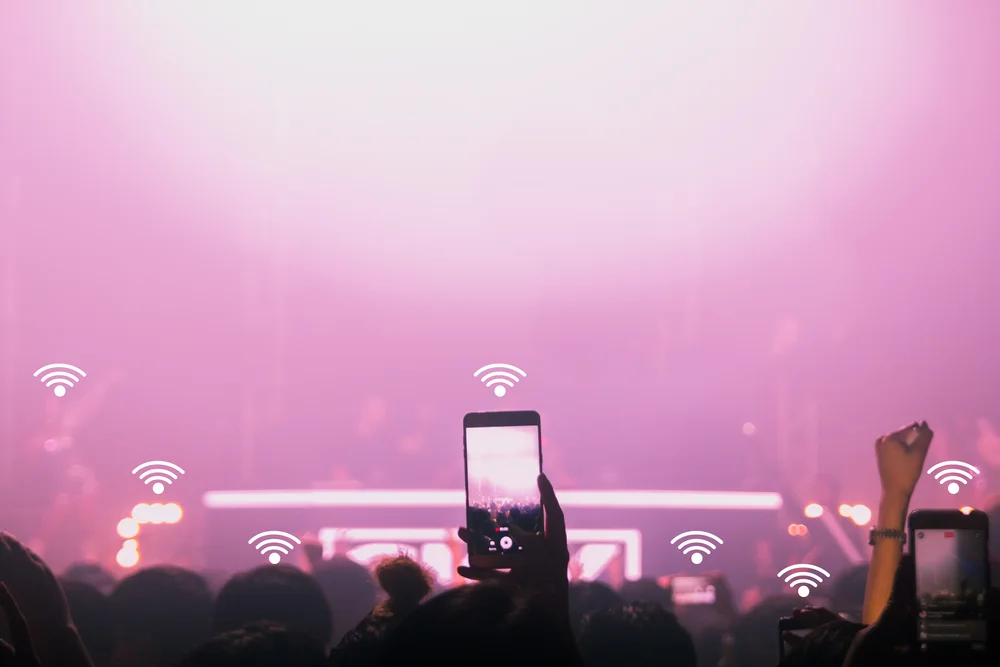
House WiFi collapses under density. A venue’s network is built for a few dozen guests checking email. Pack 500 people into that room, each with a phone, a laptop and a smartwatch, and the access points get overwhelmed. Everyone has “full bars” and nothing loads. The problem isn’t signal strength — it’s capacity. Event connectivity is a density problem, and it requires hardware designed for hundreds of simultaneous connections, not a better antenna.
A single hotspot is a single point of failure. A phone hotspot or one consumer router has no backup. One overloaded cell tower, one tripped breaker, one overheated device, and the entire event goes dark with no way to recover. Professional event networks are built the opposite way: every critical layer has a fallback.
Real event infrastructure solves both. Here’s how the pieces fit together.

The Four Layers of Event Connectivity
1. The Internet Source — Bring Your Own Pipe
You cannot assume the venue’s internet will hold, and at remote sites there often isn’t any. So we bring the source with us and, wherever the stakes justify it, we bring two.
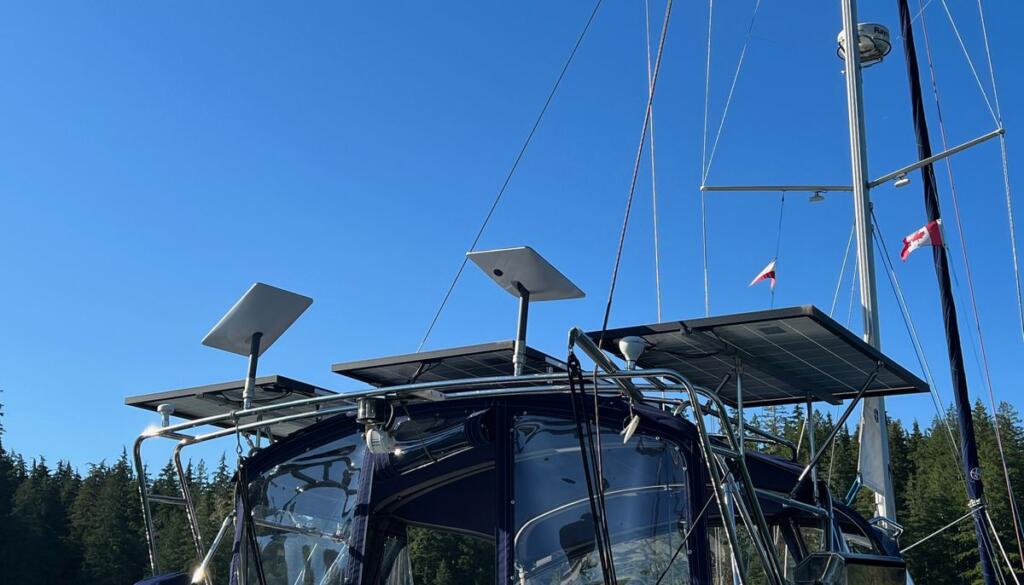
- Satellite (Starlink): For remote fields, rooftops and off-grid locations with no wired option, a managed satellite terminal delivers real broadband from anywhere with a clear view of the sky. It’s the single biggest reason “there’s no internet out there” is no longer a dealbreaker.
- Bonded cellular: Multiple 4G/5G connections combined into one resilient link, ideal as a primary source in covered areas or as automatic failover.
- Venue fiber, when it exists and is trustworthy: We’ll use it — as one input into a managed system, never as the whole plan.
The magic isn’t any single source. It’s load-balancing and failover: multiple sources feeding one managed router so that if one drops, traffic reroutes instantly and no one at the event ever notices.
2. Distribution — Getting the Signal Across the Site
Once you have internet at one point, you have to move it across the venue. At a field event with structures hundreds of feet apart, running cable is slow, expensive, and often not allowed.
The answer is a wireless mesh — a point-to-multipoint network. A central antenna, mounted high on a mast, beams the connection to compact receivers at each tent, stage or building. Modern 5 GHz links carry a solid, high-bandwidth signal well past 1,000 feet with clear line of sight — connecting an entire multi-zone site back to one internet source with no trenching. Where one building blocks another, we simply relay through it. It’s the same technology rural wireless ISPs use to cover miles; at event distances, it’s rock-solid.
3. Access — High-Density WiFi Attendees Actually Feel
This is the layer guests experience. We design it from an on-site RF survey — walking the space, measuring interference, and mapping where the crowd will be — then place enterprise access points and tune them for the load. Managed by a central controller, the network hands devices smoothly from one access point to the next as people move, and keeps performance steady whether 50 or 5,000 devices are connected. Critical systems like registration and payments get their own segmented network (a VLAN), isolated from public attendee WiFi so a crowded guest network can never slow down the front door.
4. On-Site Systems & Support — Servers, Networking, and a Human on Standby
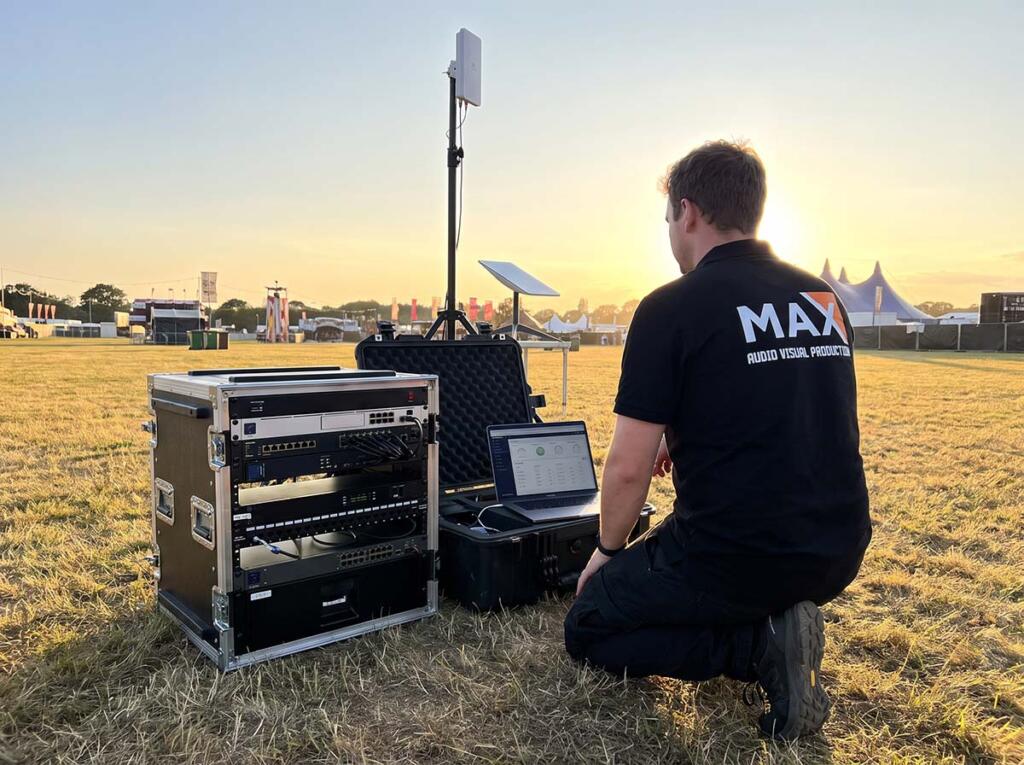
The backbone tying it together is enterprise networking gear — managed switches, routers, on-site servers for local media and registration data, redundant power (UPS), and surge protection at every outdoor run. And the most important component isn’t hardware at all: it’s a dedicated technician on-site for the full event, watching the network live and fixing issues the instant they appear. Events don’t get a second take. Someone has to be watching.
A Real-World Example: Connecting Six Buildings on a Remote Property
Here’s a scenario straight from a recent connectivity brief — six structures spread across a remote property, roughly 800 feet apart, no fiber anywhere in reach.
The design: a single managed internet source (satellite, with cellular failover) at a central point. From there, a mast-mounted omnidirectional antenna broadcasts in every direction to compact receivers at each of the six buildings. Each receiver hands off to a local WiFi access point inside its building, so every structure gets the same fast, stable connection — all managed from one dashboard, with per-building bandwidth controls so no single location can starve the others. No fiber. No trenching. One clean wireless backbone covering the entire property.
That’s the difference between “there’s no internet out here” and a fully connected multi-building event site.
What to Ask Before Your Next Remote Event
If you’re planning an event where connectivity matters, pressure-test the plan with these questions:
- How many devices will actually connect at peak? (Not headcount — headcount times two or three.)
- What’s the backup if the primary internet source fails? If there’s no answer, there’s no plan.
- Are registration and payments isolated from public WiFi?
- Has anyone done an on-site survey, or are we guessing at coverage?
- Is there a dedicated technician on-site, or just gear dropped off?
If those answers aren’t solid, the network is the biggest unmanaged risk in your production.
Event WiFi Mesh
Most events treat connectivity as an afterthought — bolted on after the audio, video and staging are booked. That’s exactly how it fails. When the same team that runs your live stream, audio and video also designs the network, the infrastructure is built around the production from day one. One point of contact. One plan. One team accountable for every packet, from the site survey to teardown.
Max Audio Visual Production delivers event IT infrastructure and on-demand connectivity across Atlanta and beyond — on-demand WiFi, wireless mesh, Starlink and satellite internet, on-site servers, remote mobile connectivity and full on-site IT support. If your next event depends on staying online, let’s design a network that simply works.
for the entire show.