
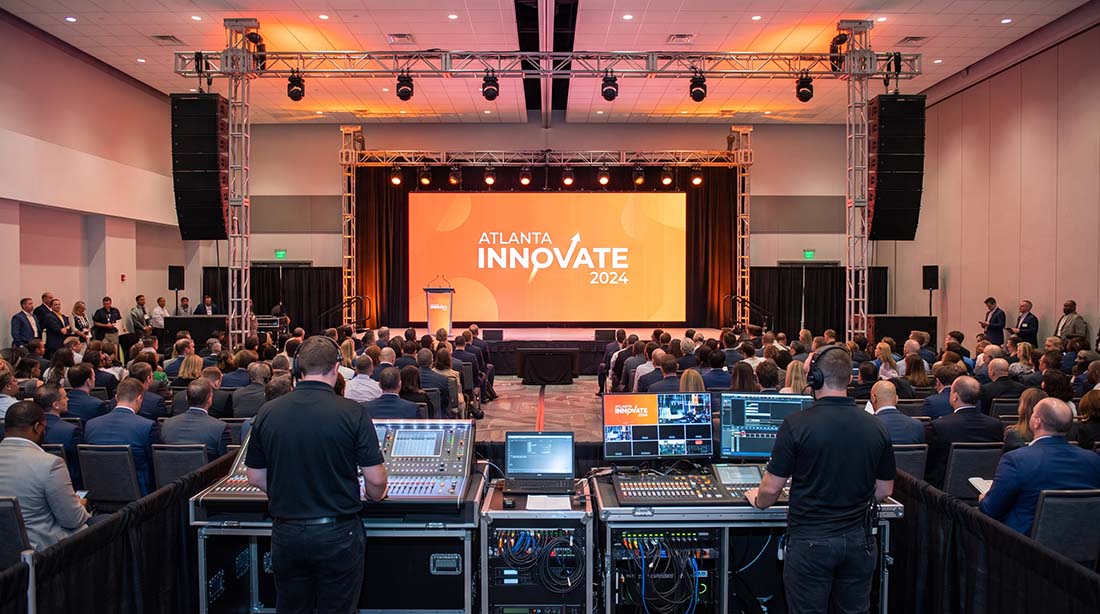
Pulling off a great event takes a hundred moving parts. Venue logistics, catering, signage, décor, and a long list of things happening quietly behind the scenes. Yet when the doors close and people head home, most of them remember only two things: what they heard and what they saw. That is the part audio visual does, and it is the part that makes or breaks the message.
Across Atlanta, planners range from solo corporate event managers to full production teams, and the constant is the same. AV either makes the message land or leaves the room disconnected. Getting it right is not about owning the flashiest gear. It is about using the right gear the right way, with people who can adapt fast when something unexpected happens. Something always does.
Why AV matters more than people realize
From the outside, audio visual looks simple. Put a mic on stage, press play on the video, done. The gap between “good enough” and “nobody noticed the tech” is far wider than it looks on paper.
Clear audio keeps an audience locked in. A weak microphone or a poorly placed speaker can flatten even a brilliant keynote. Sharp visuals do the opposite, giving the room energy whether the screen is showing a slide deck, a live camera feed, or a sponsor reel. And every piece of it has to run without a stumble, because a single glitch is the thing people remember.
That standard is the foundation of every audio setup and video production we put on an event. The goal is never for the technology to impress. The goal is for nobody to think about it at all.


Knowing the venue is half the job
Gear experience is one thing. Venue experience is another, and in a city like Atlanta it matters just as much. The spaces here are wildly different from one another, and each one changes how a setup behaves.
Hotel ballrooms in Buckhead and Midtown, convention space at the Georgia World Congress Center, historic halls, and industrial event lofts all bring their own quirks. A loft with beautiful natural light looks stunning in person but can wash out projection unless you plan for it, which is exactly where bright LED video walls earn their keep. A room with low ceilings rules out a flown screen, so ground-support options come in instead. A tight event-day schedule means pre-rigging the night before so the morning stays calm.
Knowing these things ahead of time is what keeps a show on track. It is also what saves a planner from discovering a problem at the worst possible moment.
Why LED totems and video walls keep winning
There has been a clear shift in what clients ask for. More planners want visuals that feel modern without swallowing the entire room, and that is where LED formats pull ahead of traditional projection.
LED totems are freestanding vertical displays, essentially a tall digital poster. They work beautifully in lobbies and at entry points for sponsor loops, welcome messages, and live schedules. They are bright, easy to update mid-event, and they do not block sightlines or eat floor space.
Modular LED panels are the other side of it. They snap together into large seamless video walls with no awkward aspect ratios and far better brightness than projection in most lighting. Because they are modular, the wall can go wide, tall, or even wrap a corner. When the visuals need to carry the message, whether that is a live feed, high-resolution graphics, or animated branding, LED is the format that delivers. Pairing those walls with reliable live streaming also extends the same crisp visuals to a remote audience.
Familiarity with local venues saves real time and real stress. Understanding load-in routes, room layouts, and how certain setups behave in a given space means fewer surprises and faster solutions on the day.
What we ask before quoting a job
No two conferences are the same, so no two AV packages should be either. Before we build a rental or production quote, a few questions shape everything:
- How big is the audience?
- What kind of content is on screen? Slides, video, a livestream, or all three?
- Will speakers stay at a podium or move around the stage?
- What does the room actually look like? Photos help a lot.
- Do the sessions need to be recorded or streamed?
Those answers let us recommend gear that is neither overkill nor short of what the room needs. The point is not to upsell. The point is a show that runs smoothly so the AV becomes the last thing you have to think about once it starts.

Working with a team that knows Atlanta
Familiarity with local venues saves real time and real stress. Understanding load-in routes, room layouts, and how certain setups behave in a given space means fewer surprises and faster solutions on the day.
That is the advantage of a single accountable team. Max Audio Visual Production plans, builds, and runs the full technical production, bringing audio, video, lighting, LED, and streaming together under one lead instead of splitting them across vendors who have never worked the room. For corporate events especially, that kind of coordination is the difference between a calm event day and a scramble.
When the AV works, no one notices
The best compliment in this business is silence. If the sound is clear, the screens are sharp, and nothing skips a beat, your audience stays focused on the content and the AV disappears into the background. That is exactly the point.
If you are planning a conference or corporate event in Atlanta and want the technology handled by one team from first call to final strike, we would love to help you sort out what is worth doing and what is not.
Ready to talk it through? Request a quote and get a clear, single-source plan within two business days.